
Sitemap
A list of all the posts and pages found on the site. For you robots out there, there is an XML version available for digesting as well.
Pages
Posts
Future Blog Post
Published:
This post will show up by default. To disable scheduling of future posts, edit config.yml and set future: false.
Blog Post number 4
Published:
This is a sample blog post. Lorem ipsum I can’t remember the rest of lorem ipsum and don’t have an internet connection right now. Testing testing testing this blog post. Blog posts are cool.
Blog Post number 3
Published:
This is a sample blog post. Lorem ipsum I can’t remember the rest of lorem ipsum and don’t have an internet connection right now. Testing testing testing this blog post. Blog posts are cool.
Blog Post number 2
Published:
This is a sample blog post. Lorem ipsum I can’t remember the rest of lorem ipsum and don’t have an internet connection right now. Testing testing testing this blog post. Blog posts are cool.
Blog Post number 1
Published:
This is a sample blog post. Lorem ipsum I can’t remember the rest of lorem ipsum and don’t have an internet connection right now. Testing testing testing this blog post. Blog posts are cool.
courses
00 Course Notes - Reading Order
Course Notes - Reading Order
01.1 Basics of Open Loop
Derivation of P(s) - Second-Order System
01.2 DC Gain Explained
DC gain is the steady-state output of a system when you apply a constant (DC) input. “DC” comes from electronics-direct current means zero frequency.
01.3 Natural Frequency, Poles, Damping (2nd Order System)
Eigenvalues = Poles
Explanation: Eigenvalues and poles are the same thing!
01.4 Damping Ratio and Resonance
As soon as the damping ratio, $\zeta$ goes below $0.707$, we will start to see resonance. $\zeta = 0.707$ is the smallest value to have a constant $0dB$ effect like the following:
01.5 Bandwidth Definition
Definition: For a second order system, draw a $-3dB$ line. Where the $-3dB$ line and the frequency response function intersect, their corresponding frequency is the “Bandwidth of the system”
01.6 Decibel Interpretation
Just one rule to visualize
- $20 dB$ is a factor of 10
- Hence, $40 dB$ is a factor of 100
- $3 dB$ is basically of factor $\sqrt2$ (But $-3 dB$ is a factor of $\frac{\sqrt2}{2}$)
$6 dB$ is a factor of $2$ (But $-6 dB$ is a factor of $0.5$ )
For reference, I am adding the whole table here:
02.1 Basics of Closed Loop
What is an Open-Loop Plant?
02.2 Closed Loop System with Feedback Control
Block Diagram
02.3 Gain Margin and Phase Margin
Let’s say, you have a gain margin of $6+0.1 dB$, what does that mean?
02.4 Controller or Compensator Design
When we are adding a controller/compensator into our system (by system, I mean, the state-space with the observer and with the control gains), what is the transfer function of that controller? By the way, a compensator just means the controller block that sits between the measured plant output and the plant input.
But why would we want a transfer function for controller or compensator?
03.1 Creating a LTI Object in MATLAB - Part 1
There are many ways to create an LTI object in MATLAB. However, the most conventional are two methods.
- State-Space to LTI
- Transfer Function to LTI In my experience, if you don’t have both the equations- only the ODE, always go for constructing Transfer Function first and then convert it to LTI. Reason is if you don’t know the exact mapping of $y=Cx+Dy$ then you might end up with wrong result.
03.2 Creating a LTI Object in MATLAB - Part 2 (Conversion)
State-Space to Transfer Function
Method 1 (Analytical)
03.3 State-Space Info from LTI Object
If you have an LTI object say, H_sys. And you would like to extract, A, B , C , D matrix, then use the following
03.4 Impulse Response Function Plotting
TODO: HW from Applied Linear System
03.5 sgrid Code for s-plane
``` octave figure; hold on;
03.7 Drawing Block Diagram in LaTeX
| Link: [Courses and Educational Talks | MACS LAB](https://macslab.xyz/teaching/) |
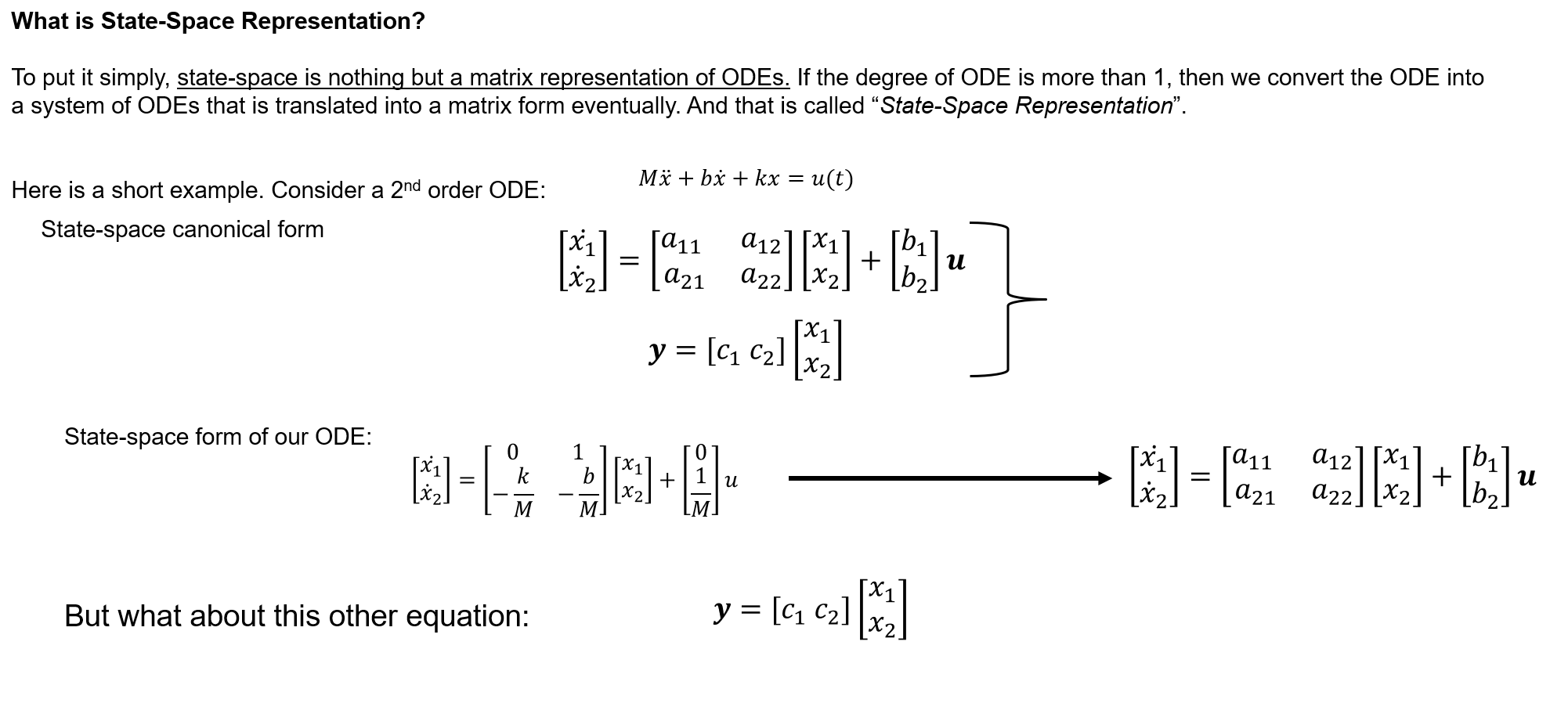
04.1 Why Do We Bother with State-Space Realization
That is a very insightful way to frame it. You’ve hit on the core “engineering” reason why we bother with state-space realizations in the first place. While transfer functions are great for intuition in the frequency domain, state-space is where the heavy lifting happens for complex systems.
04.3 Transfer Function Matrix - A Misconception
From 03.1 Creating a LTI Object in MATLAB - Part 1, there might be a misconception that transfer function, $\mathbf{H}$ is a single polynomial. Something like the following:
05.1 Controllability 1
The idea of controllability is best understood through the following example. Again, it all starts with a state-space representation (or, in MATLAB lingo, an LTI object).
05.2 Controllability 2
Once we get the basic intuition from 05.1 Controllability 1, how do we know that if a system is controllable? There are couple of ways actually to do this. They are as follows:
05.4 Full State Feedback - Part 1
We start with a state-space system where we have $A,B,C,D$ defined, right? We can refer to the MIMO system mentioned in 04.3 Transfer Function Matrix - A Misconception.
06.1 Luenberger Observer (State Estimation) - Full State Feedback - 2
From 05.4 Full State Feedback - Part 1, we know that control gain, $G$, is applied to all the states, right? But in practice, we typically do not have all the states. So we estimate them. Now, the question is: how do we estimate them?
06.2 Luenberger Observer - 2
MATLAB Implementation of Luenberger Observer and Why this observer problem looks like a 05.4 Full State Feedback - Part 1
06.3 Observer (State Estimator) and Augmented System
We have cleared up the confusion regarding the 06.1 Luenberger Observer (State Estimation) - Full State Feedback - 2. By the way, observer means state estimator!
06.4 Augmented System - 2 with Control Command
Once we complete 06.3 Observer (State Estimator) and Augmented System, we would incorporate the control law into the augmented system.
07.1 Integral Control (LQR) - Part 1
We have come a long way from open-loop plant 01.1 Basics of Open Loop to closed-loop plant 02.2 Closed Loop System with Feedback Control.
07.2 Integral Control (LQR) - Part 2
As we kind of defined why we needed a controller state, now we would like to incorporate that into our augmented system, right? 07.1 Integral Control (LQR) - Part 1
07.3 Draft - Summary Equations for Closed Loop, Observer, Controller
| Closed Loop Only | Observer w/ Closed Loop | Full-State Feedback w/ Observer & Controller |
|---|---|---|
07.4 Wrapping Up - 1
Summary
Applied Linear Control
Course notes for Applied Linear Control.
Applied Linear Systems
Course notes for Applied Linear Systems.
portfolio
Portfolio item number 1
Short description of portfolio item number 1
Portfolio item number 2
Short description of portfolio item number 2
publications
Paper Title Number 1
Published in Journal 1, 2009
This paper is about the number 1. The number 2 is left for future work.
Recommended citation: Your Name, You. (2009). "Paper Title Number 1." Journal 1. 1(1).
Download Paper | Download Slides | Download Bibtex
Paper Title Number 2
Published in Journal 1, 2010
This paper is about the number 2. The number 3 is left for future work.
Recommended citation: Your Name, You. (2010). "Paper Title Number 2." Journal 1. 1(2).
Download Paper | Download Slides
Paper Title Number 3
Published in Journal 1, 2015
This paper is about the number 3. The number 4 is left for future work.
Recommended citation: Your Name, You. (2015). "Paper Title Number 3." Journal 1. 1(3).
Download Paper | Download Slides
Paper Title Number 4
Published in GitHub Journal of Bugs, 2024
This paper is about fixing template issue #693.
Recommended citation: Your Name, You. (2024). "Paper Title Number 3." GitHub Journal of Bugs. 1(3).
Download Paper
Paper Title Number 5, with math \(E=mc^2\)
Published in GitHub Journal of Bugs, 2024
This paper is about a famous math equation, \(E=mc^2\)
Recommended citation: Your Name, You. (2024). "Paper Title Number 3." GitHub Journal of Bugs. 1(3).
Download Paper
talks
Talk 1 on Relevant Topic in Your Field
Published:
This is a description of your talk, which is a markdown file that can be all markdown-ified like any other post. Yay markdown!
Conference Proceeding talk 3 on Relevant Topic in Your Field
Published:
This is a description of your conference proceedings talk, note the different field in type. You can put anything in this field.
teaching
Teaching experience 1
Undergraduate course, University 1, Department, 2014
This is a description of a teaching experience. You can use markdown like any other post.
Teaching experience 2
Workshop, University 1, Department, 2015
This is a description of a teaching experience. You can use markdown like any other post.